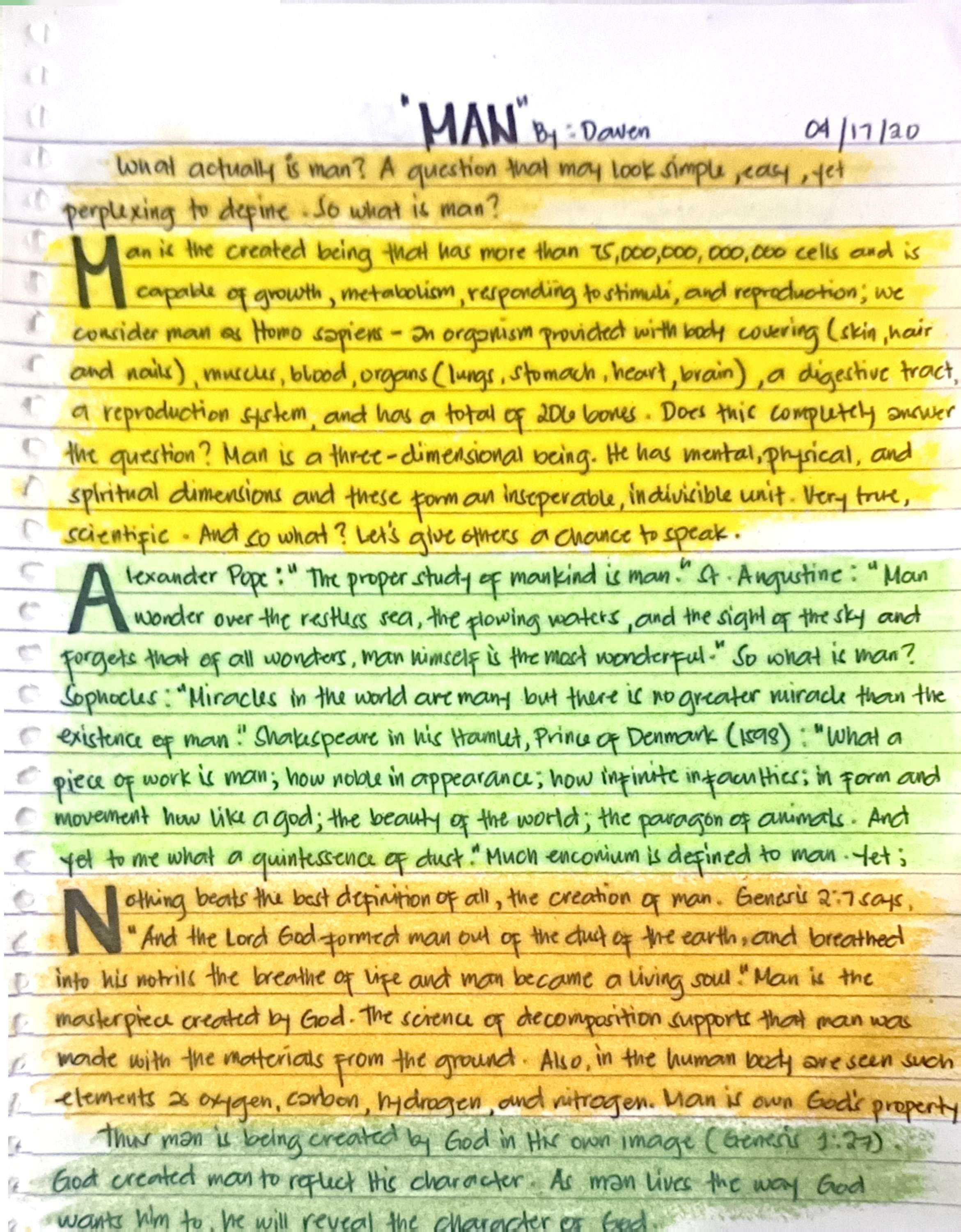
MAN original manuscript
What actually is man?
A question that looks simple, yet grows deeper the more we ask.
Man is a created being made of countless living cells,
capable of growth, metabolism, response to stimuli, and reproduction.
Biology calls him Homo sapiens:
a body clothed with skin and hair,
filled with muscles, blood, and organs - lungs, stomach, heart, brain -
with a digestive tract, a reproductive system, and 206 bones joined together.
But if we stop there, we have only described a shell.
Man is also mind and spirit;
a three-dimensional being whose physical, mental, and spiritual sides
form one inseparable whole.
Across history, many voices have marveled at this mystery.
Thinkers looked over the restless sea and the glowing stars,
yet confessed that of all wonders, man himself is the most astonishing.
Our species writes symphonies and starts wars,
builds hospitals and prisons, heals and harms with the same hands.
Poets have called man a "noble creature,"
"infinite in faculties," "the beauty of the world,"
and yet also a "quintessence of dust."
Praise and contradiction cling to us,
as if humanity is caught between glory and frailty.
Nothing, however, defines man more clearly
than the account of his creation.
"Then the Lord God formed man of the dust of the ground
and breathed into his nostrils the breath of life;
and man became a living soul" (Genesis 2:7).
Science of decomposition agrees that our bodies return
to the same elements found in the earth -
oxygen, carbon, hydrogen, nitrogen, and more -
all drawn from the ground and given back to it when we die.
Yet Scripture adds what no microscope can see:
that man is God's masterpiece, made from dust yet crowned with His image,
owned by God, intended to reflect His character in the world.